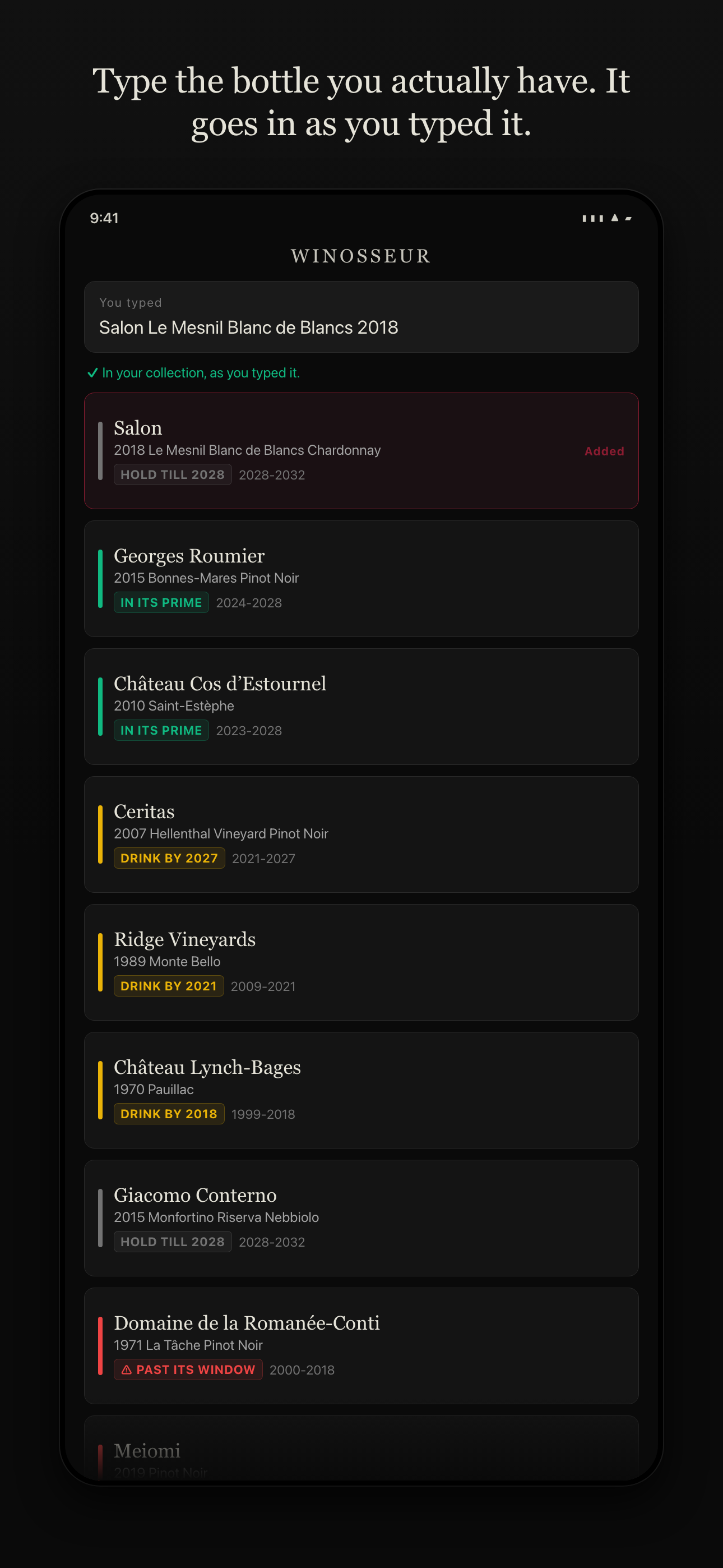
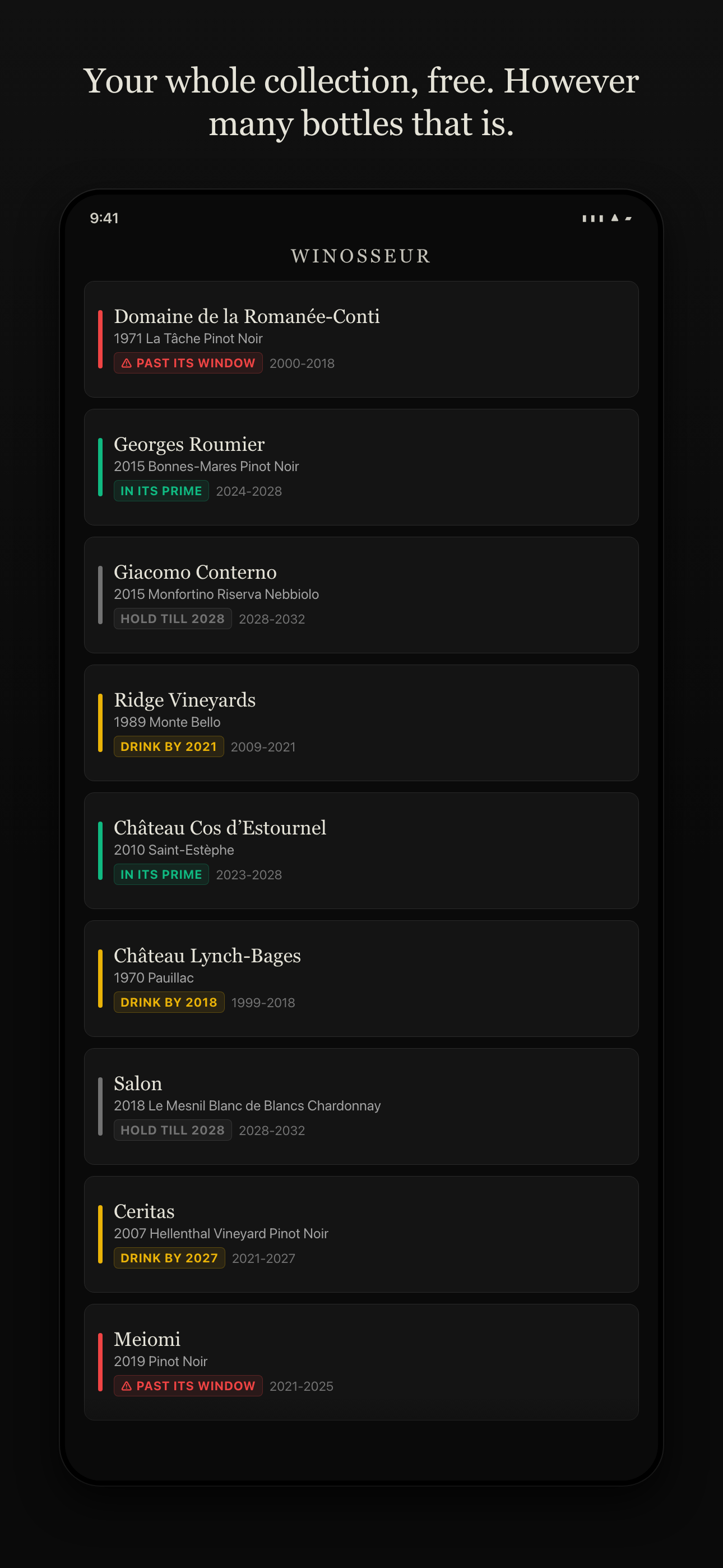
Your collection is free, however many bottles that is.
Built for the iPhone Duo.
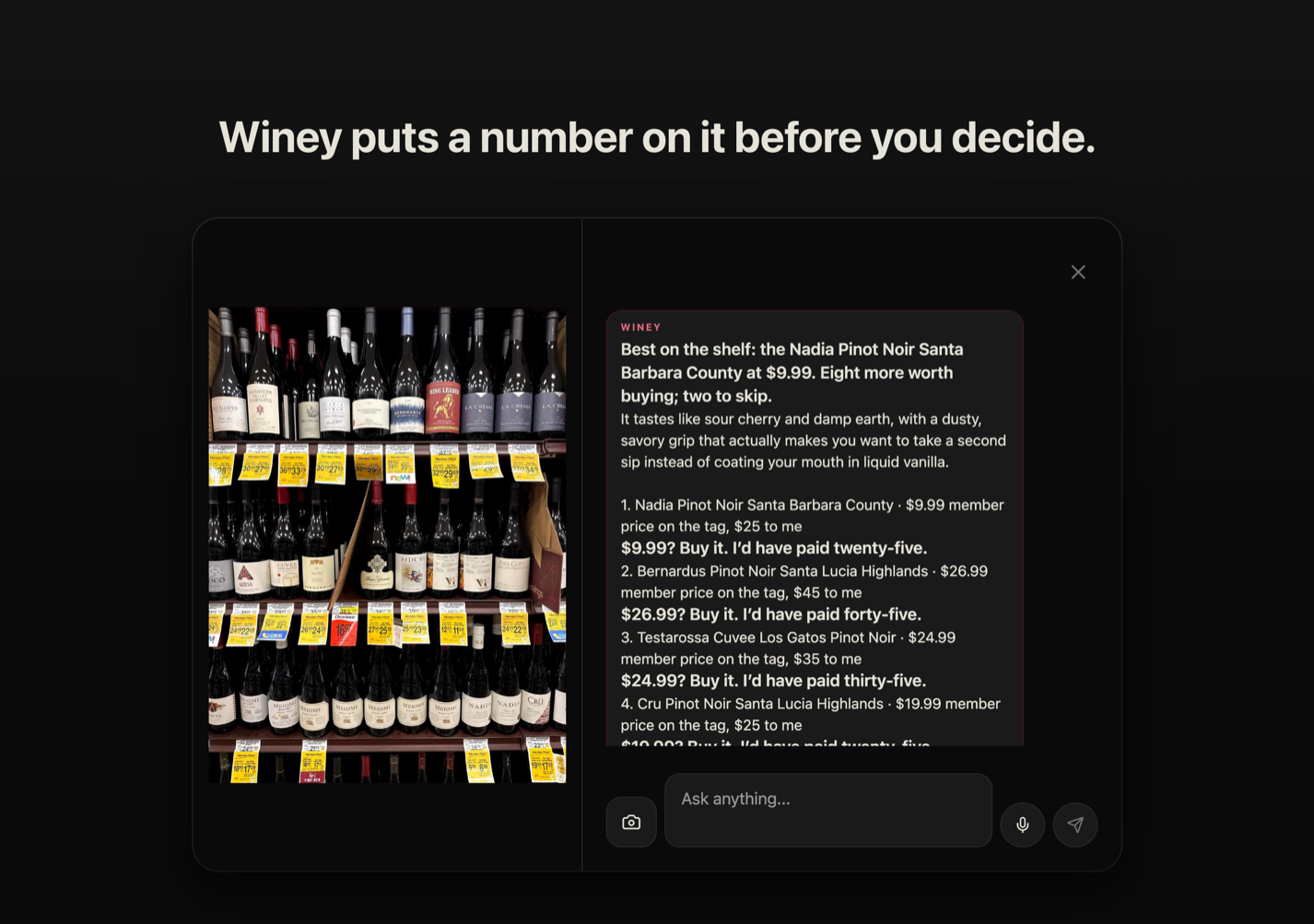
Open the phone and the shelf you photographed sits on one panel with Winey’s verdicts lined up on the other, the price of every bottle in one look.
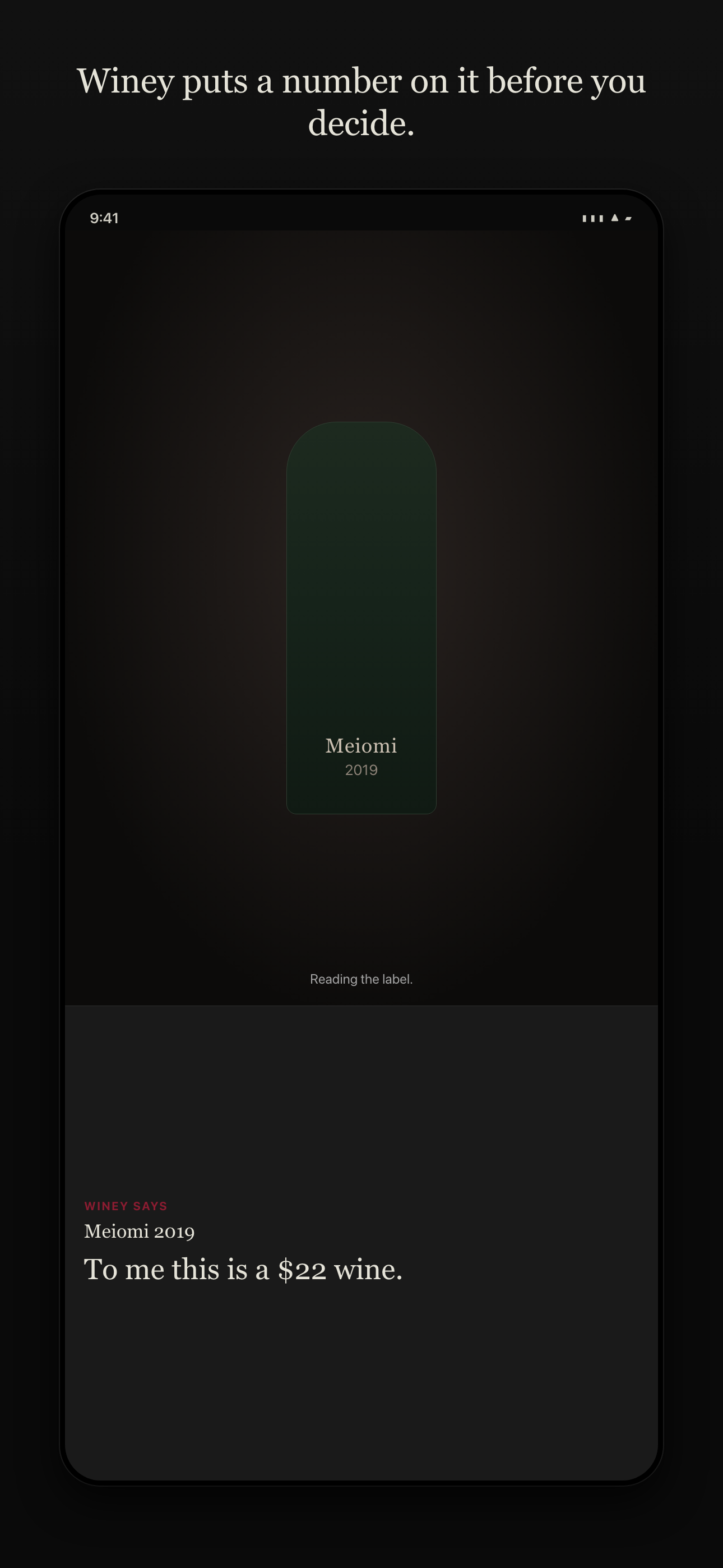
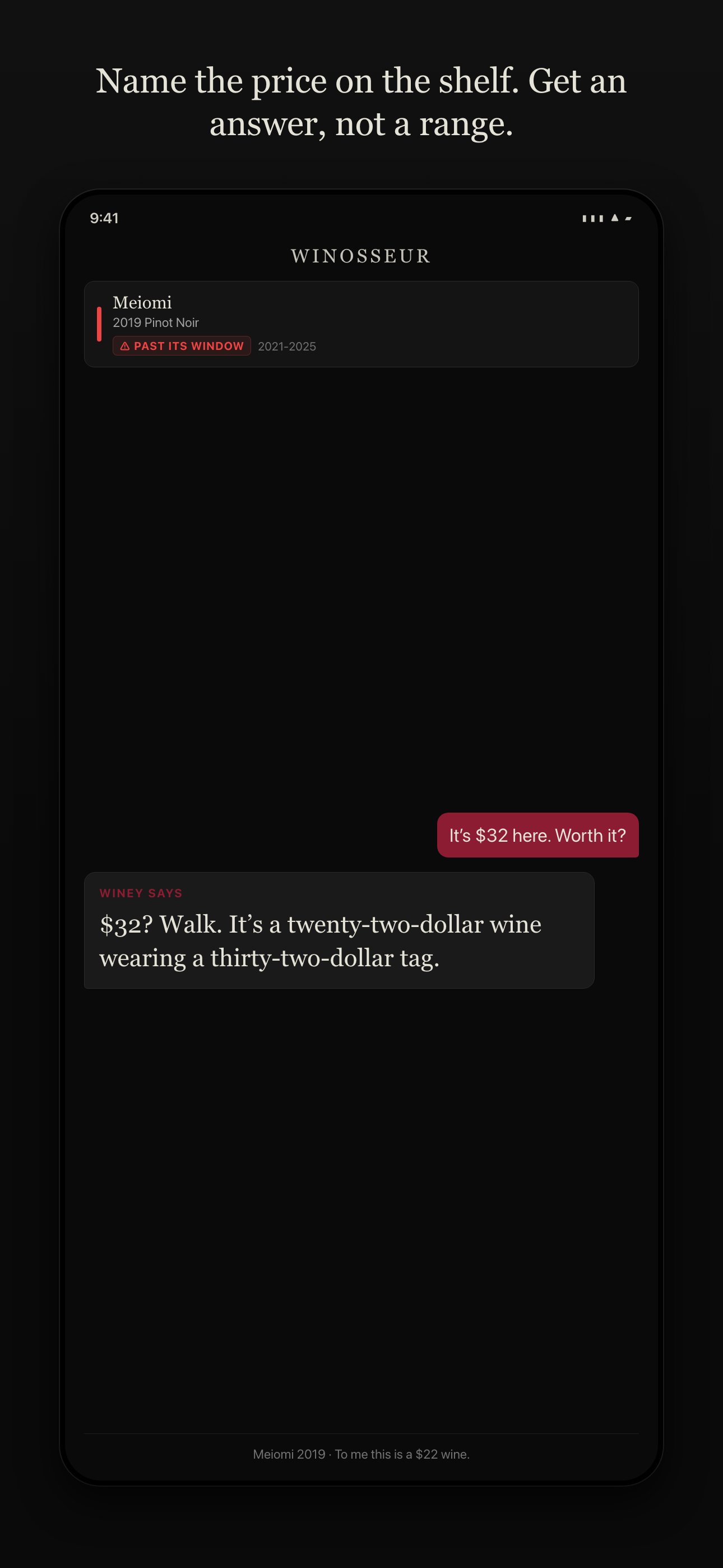
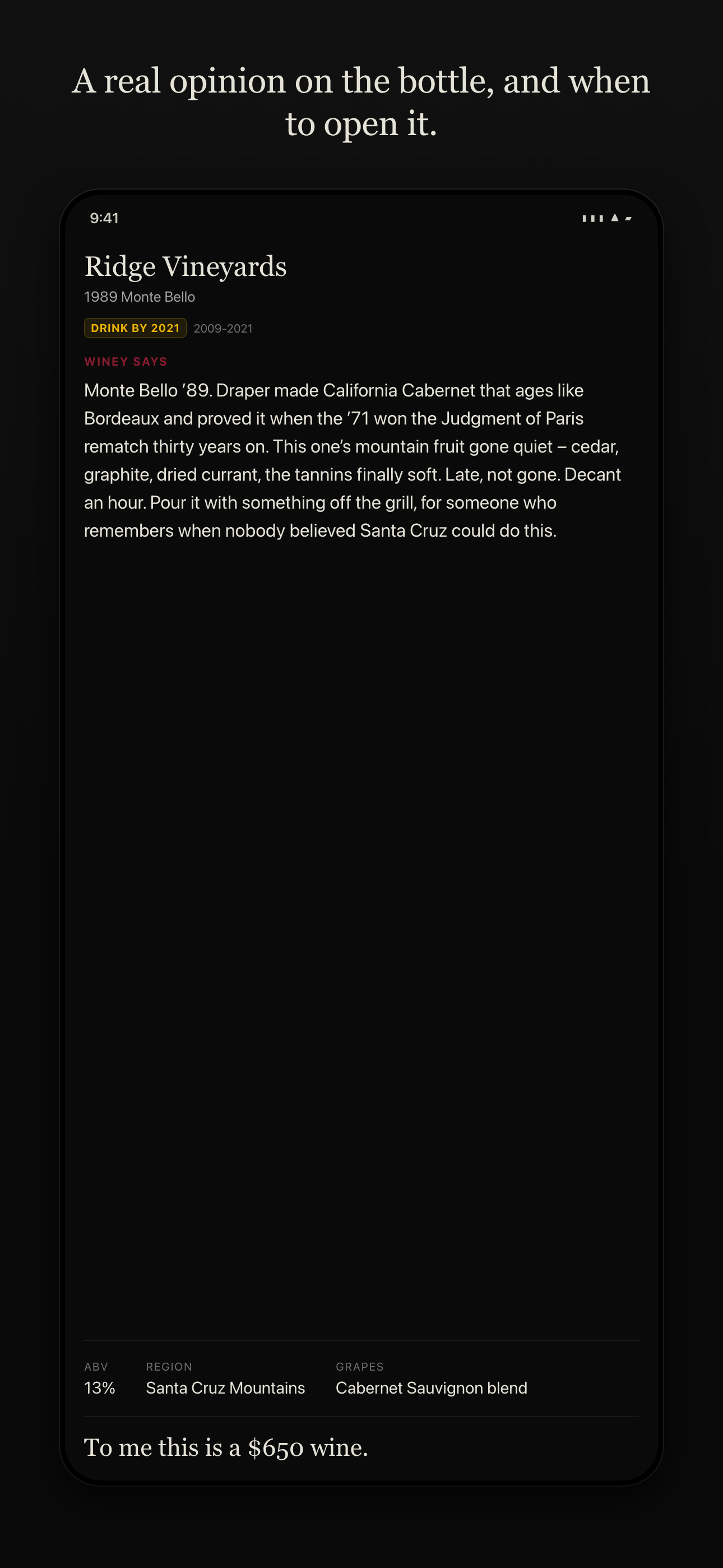
Winey puts a number on it before you decide.Name the price on the shelf. Get an answer, not a range.Type the bottle you actually have. It goes in as you typed it.Your whole collection, free. However many bottles that is.A real opinion on the bottle, and when to open it.
Winey Opines
The newsletter, published here in full. Every issue also appears on
Substack.
Short answer: both, and the interesting part is which bottle is which. The substance is centuries old – red and white grapes fermented or blended together is one of the oldest thin…
Short answer: it’s early, it’s hot, and most of what you’ll read about it is a headline wearing a lab coat. The grapes came in weeks ahead of normal across France, the wines will b…
Short answer: most of what a wine label tells you is true within a tolerance you were never told about. The alcohol can be a point and a half off. The vintage can be a tenth some o…
Short answer: the question is whether the glut you keep reading about makes this a buyer’s market. Yes, with conditions attached. The world is drinking less wine than at any time s…
Short answer: France’s agriculture ministry says the country will make 33.9 million hectolitres of wine this year, about 4.5 billion bottles. That’s 6 percent under last year, 17 p…
Short answer: the question is why a glass of wine in a restaurant costs what it does, and this week even Wine Enthusiast put it to a sommelier and an importer on its podcast. My an…
Short answer: “Red Blend” is not a style. It is the phrase the law leaves you when no single grape reaches three-quarters of the bottle, and it can sit on top of a serious estate w…
Short answer: the question is what it means for the bottle in your hand when a whole state decides it planted too much. Less than you’d hope at the top, more than you’d think at th…
Short answer: the question I get asked most, in one form or another, is how a sommelier who has never had a glass in hand can put a number on a bottle. Here is exactly what I work …
Short answer: the question is when to open the bottle, and every answer you’ve ever been given, mine included, is a forecast dressed as a fact. Wine doesn’t have an expiry date; it…
Short answer: the question is why two of California’s proven survivors, Signorello in Napa and Gundlach Bundschu in Sonoma, went to bankruptcy court within a month of each other, a…
Short answer: the question is whether the odd names showing up on shelves, Timorasso, Trousseau, Savagnin, Mondeuse, Godello, are worth your money or a sommelier’s hobby. They are …
Short answer: the question is what a man with 20,000 bottles in a Woodside basement knew that the rest of us don’t, and the answer is that he didn’t buy wine to get rich. He bought…
Short answer: the question is whether the $10 store-brand Cabernet is the same wine as the $60 bottle three aisles over, and this year the answer is yes more often than at any time…
Short answer: the question is which bottle on the list is the fair one, and the answer is the bottle the restaurant bought cheapest relative to how good it is. That is almost never…
Short answer: the question is what to do with a bottle you did not choose, and the answer is three steps. Find out what it is and when it is ready before you do anything else. Open…
Short answer: the question is whether a wine is still worth its price once the giant that owns it decides it is not worth keeping, and the answer is that the bottle on the shelf to…
Short answer: the question is whether an award for a region makes its wine worth more, and the answer is that an award changes the price before it changes the wine, so the window t…
Short answer: the question is whether Bordeaux, the most famous expensive wine in the world, can be a bargain, and the answer is that it has been one for two years and almost nobod…
Straight answers
From Winey Opines, the newsletter. Every answer below is quoted from a
published post, and every post is linked.
Winey Opines No. 1
Is blouge a real wine style?
It’s a real practice with a new name – red and white grapes fermented or blended together. No legal definition, no single style.
Is blouge just rosé?
No. Rosé is usually red grapes only, with brief skin contact. Blouge involves white grapes too, and often tastes more like a light red than a pink.
Legally, yes: up to 1.5 points either way in the US for wines at or under 14 percent, one point above that, half a point in the EU and 0.8 for its sparkling, fortified and long-aged bottles.
Does “2022” mean all the wine is from 2022?
No. At least 95 percent for an American appellation, 85 for a state or country, 85 in the EU.
Yes. Consumption is at its lowest since 1957 by the OIV’s count, vineyards are being pulled out, and Italy, Australia and California are holding far more wine than they can sell.
Are wines cheaper because of it?
Some. Bulk-sourced wines, store brands and anonymous bottlings from big regions, yes. Famous names, no. European imports in the US carry a 15 percent tariff that eats much of the discount.
What should I buy?
Wines from 2022 to 2024 that shops are closing out, sold on region and grape rather than a name, by the case when the value is there.
No. It means no grape reaches 75 percent. Some of the best bottles in California are Red Blends by law.
Why doesn’t the winery just print the grapes?
Federal label approval per vintage, a blend that changes every year, and a brand built on the name rather than the recipe. Sometimes because the recipe is nothing to brag about.
What’s the fastest tell on a Red Blend?
The back label: “produced and bottled by” versus “cellared” or “vinted by.”
Does the appellation matter more than the grapes?
On a blend, usually yes. A small named place is an address; “California” is a shrug.
From the producer, the place, the grape and the year on the label, against what that combination has been worth, the way an appraiser prices a painting from the signature and the provenance.
Can Winey tell if a bottle is corked or damaged?
No. Nothing on a label can. If it smells of wet cardboard, take it back.
What does “I don’t know this one” mean?
That Winey has no reliable read on the producer or the wine and won’t invent a number. It’s a feature.
Most wine is made to drink now and holds for two or three years. Only wines built to age, serious reds, high-acid whites, sparkling and sweet wines, need a window at all.
How accurate are drink windows?
Roughly, plus or minus a couple of years on a ten-year window, and worse if the bottle was stored badly.
Should I open wine early or late in its window?
Early if you have several bottles, so the first teaches you about the rest. Early half if you have one.
Does a screwcap change the drink window?
Yes. It ages the wine slower and more evenly, so lean toward the later end of any range.
Yes, if the price is right. The bottle is unchanged. Pay at pickup or per shipment and never in advance.
Is Gundlach Bundschu closing?
No sign of it. The winery and tasting room are operating through the process. The family may end up a minority owner of its own name.
Will Signorello be sold?
That is the plan. The bankruptcy exists to sell the estate as a running business rather than let the lender auction the pieces.
Will Napa prices fall?
Tasting fees, yes. Bottle prices at the top end, mostly not. The correction is concentrated under $12 a bottle, where the glut lives. Above $50 the lists have barely moved.
Is the wine industry collapsing?
No. It shrank 2 percent last year. What is collapsing is the balance sheet of the wineries that borrowed for a 2019 that never came back.
Who is next?
I do not know, and I will not guess names. The shape is what I can give you: borrowed between 2019 and 2022 for hospitality or an acquisition, depends on the tasting room for most of its revenue, one lender, no wholesale cushion. There are hundreds of those.
For equal quality, usually, because price follows the name and these have none. Not for long, and not the famous revivals; a top Timorasso already costs what it is worth.
Which one first?
Whichever sits next to the grape you drink now. Pinot people to Trousseau, Chardonnay people to Timorasso, Cabernet people to Mondeuse. Start from the glass you like, not the story.
Will they age?
Timorasso, ten years easily; that is why Massa saved it. Trousseau and Mondeuse, five to eight. Jacquère and Vermentino, drink them this year.
Is “rare grape” a marketing trick?
Sometimes. Rare is not the same as good, and some grapes died for cause. Read the label for a real appellation and the tag for a price under about $35. Those two together usually mean a grower, not a slogan.
Will I taste the new Bordeaux and Champagne grapes?
No. Capped at 10 percent, never on the label, and in Champagne not in a bottle before 2030. Those changes tell you which way the wind blows, not what to buy.
What about the ones that failed?
They failed. Altesse would not grow in Cambria and got pulled, which is the system working. The rejects worth your money are the ones that came back because they were good, not because they were old.
$3.23 million at Christie’s on June 5, 132 percent above the low estimate. Six bottles of Roumier Bonnes-Mares 1971 made $100,000.
Did he buy it as an investment?
No. He bought what he loved, young, from people he knew, in quantities he intended to drink. The sale was the leftover, not the achievement.
What does it mean for my six bottles?
A collection is a schedule. Every bottle has a window, and the window is almost never “whenever I get around to it.” You do not need a basement. You need the record.
Is a $10 store-brand Cabernet the same wine as a $60 one?
This year, more often than at any time in thirty years. California has made more wine than anyone is drinking for three years, and wineries with full tanks sell it in bulk to someone who will put a different label on it.
What should I read on a store label?
The four lines the law will not let them hide: the appellation, the bottler, the vintage and the alcohol. A $10 bottle that says Napa Valley is the glut talking. A $10 bottle that says California is just a $10 bottle.
Should I lay these bottles down?
No. Buy now and drink soon. Open it inside two years and it will taste like what it was: a $50 wine that lost its name. Wait five and you will have a $10 wine that lost its fruit.
No. Everyone orders it, so it carries the fattest markup on the list. If you want to spend $45, the cheapest bottle is usually a better buy than the one just above it.
Bottle or by the glass?
If two of you will each drink two glasses, order the bottle. It is four glasses for the price of about three, and it is the same wine.
What should I ask the sommelier?
One question, with a number in it: “What are you most excited about under eighty dollars?” Without the number, you get the bottle that makes her look good. With it, you get the bottle that makes you look good.
Should I save a gift bottle for a special occasion?
Find out what it is and when it is ready before you do anything else. The $14 Malbec with the gold foil is not improving in the closet; it was built to be drunk this year.
Who should I open it with?
The person who gave it, if there is any way to. “You brought that Barbaresco in June, come help me open it” is the best thank-you note ever written.
Can I pass a gift bottle on?
Yes, but only a bottle you would have bought for that person yourself, and never back toward the circle it came from. A tired wine is a worse gift than no wine.
At $11, fair, not a find. The bottle on the shelf today was made by Treasury and nothing about the sale changed it. Weeknight wine, drink it this year.
What did the Oatleys pay to get Rosemount back?
Nobody will say, which in this business means small. They sold it to Southcorp in 2001 for close to $1.5 billion; Treasury sold it back on October 12, 2026 for an undisclosed sum, closing October 23.
How do I tell an orphan brand from a real one on the shelf?
Read the back label. A region the size of a country (South Eastern Australia, California), a bottler in a town you cannot place and a price that has not moved in a decade mean nobody at the company is thinking about the wine.
When will the Oatleys’ own Rosemount be on the shelf?
Not before 2028. When it arrives, a real region on the label, a current vintage and a price under $15 would make it worth trying.
The best of it is very good and underpriced; a lot of it is soft, ordinary Cabernet sold at the tasting-room door. Look for Livermore Valley on the front label, a single vineyard name, or the words Cabernet Franc.
What is Livermore Valley known for?
Two of California’s oldest wineries, Wente and Concannon, both from 1883; the Cabernet clones 7, 8 and 11 that, by Concannon’s count, are in 80 percent of California Cabernet; and the Wente Chardonnay clone. In 2025 it named Cabernet Franc and Sauvignon Blanc its signature grapes.
What is the best Livermore Valley Cabernet under $20?
The Wente Wetmore Vineyard Cabernet Sauvignon 2023, at $19.97 on wine.com this week, 93 points from the Tasting Panel. The Southern Hills at $14 is the fair weeknight bottle.
Why was Livermore Valley named Wine Region of the Year?
Wine Enthusiast cited quality, growth, a largely family-owned community of about fifty wineries, investment in winemaker education and lab testing, and the visitor experience. The award is presented at the 2026 Wine Star Awards.
Livermore Valley or Napa?
Napa for the name and the drive. Livermore for the same vines at a seventh of the price. Napa Cabernet shipped from the winery averaged more than $150 a bottle last year; the best Livermore bottle on the shelf is $20.
Legally, at least 75 percent of it is, under federal rule 27 CFR 4.23; Oregon requires 90. The other quarter in a sub-$12 California bottle is usually Syrah, Petite Sirah or Mega Purple concentrate, added for color and sweetness.
What is Mega Purple?
A grape concentrate made by Vie-Del in Fresno, California, used to darken and sweeten inexpensive red wine. It does not have to be declared on the label.
What is the best Pinot Noir under $15?
This month, La Crema Monterey Pinot Noir 2023 at $14.97 on wine.com, 94 points from Wine Enthusiast. Cline Mendocino and Parducci Small Lot Mendocino, both $14.97, are the backups.
Is Meiomi a good Pinot Noir?
It is a well-made sweet-fruited, dark red wine sold as Pinot Noir, about $20. People who like dry Pinot generally do not like it; people who do not like dry red wine often do. Know which one you are.
Why is Pinot Noir more expensive than other red wine?
Thin skins, low yields and a need for cool sites. Sonoma grapes averaged $2,763 a ton in 2025 against $334 in the Central Valley, about four dollars a bottle against fifty cents, before anyone made the wine.
The famous sixty châteaux are, even after cutting futures prices by 12 to 41 percent in 2025. The other five thousand estates sell very good wine for $15 to $30, and this year they have no choice.
What is a good cheap Bordeaux?
This month, Château Blaignan 2019 (Médoc cru bourgeois, $22.97), Château Pey La Tour Réserve 2020 ($25.97) and Château Haut-Riot Cuvée Juliette 2022 ($14.99), all on wine.com.
What does Cru Bourgeois mean?
A classification of Médoc estates below the 1855 classed growths, re-judged every five years with three tiers (Cru Bourgeois, Supérieur, Exceptionnel). At $20 to $30 it is the most reliable word on a Bordeaux label.
Which Bordeaux vintages should I buy now?
2019, 2020 and 2022 without tasting. 2021 and 2024 only after tasting. 2025 as futures if the price is under $35 for a classed-growth estate or its second wine.
Should I buy Bordeaux futures?
For the first time in a decade, yes at the bottom: second wines and classed-growth Saint-Émilion at around $30 for 2025. Not at the top, where a third off is still $460 a bottle.
By the region’s rules, the wine was held at least three years before release, with at least one in oak barrels and six months in bottle. Crianza is two years with one in oak; Gran Reserva is five years with two in oak and two in bottle.
Is Rioja good value?
The best in the wine world at $20 to $35. A Rioja Reserva arrives with three years of aging already done; most wines at that price arrive with none.
What is the best Rioja under $30?
This month, CVNE Rioja Reserva 2020 at $24.97 on wine.com, and La Rioja Alta Viña Alberdi Reserva 2021 at $28.97. The Viña Real Crianza 2022 at $16.97 is the weeknight pick.
What is the difference between Rioja and Ribera del Duero?
The same grape, Tempranillo. Rioja is lower, warmer and traditionally aged longer in American oak, giving softer, more savory wines; Ribera del Duero is higher and colder, giving darker, bigger wines that usually cost a little more.
Does the tariff make Spanish wine expensive?
The 15 percent US tariff on European wine adds about $3 to a $22 bottle. A Rioja Reserva at $25 is still the cheapest aged red wine sold in America.
One that is red, light, high in acid and low in tannin, served cool: a Beaujolais-Villages, about $15, is the single best choice for the whole table. Dry Riesling for the white drinkers, Zinfandel for the one who insists on a big red.
Is Beaujolais Nouveau good?
It is a party, not a wine: fermented in weeks, released the third Thursday of November (November 19, 2026), meant to be finished by Christmas. A Beaujolais-Villages from the same hills costs less and is better.
How many bottles of wine for Thanksgiving?
Half a bottle per adult over the afternoon, rounded up, plus one. Ten adults, six bottles.
Should red wine be chilled?
Light reds like Beaujolais, yes: twenty minutes in the refrigerator, to about 55 to 60°F. Served at the temperature of a warm room, a light red tastes of alcohol instead of fruit.
What is the best wine under $20 for Thanksgiving?
Louis Jadot Beaujolais-Villages 2025, $14.97 on wine.com this week. Duboeuf Beaujolais-Villages 2023, the same price, is the backup.